
Skip to content

Professional Services Council

2025 Annual Report

Picture1-1

About PSC

Screenshot_4-2-2026_115021_

PSC is the leading trade association and voice of the government contracting industry, with 400+ small, medium, and large member companies supporting federal agency missions and functions. Member companies employ hundreds of thousands of workers in all 50 states and around the world. As the most respected industry leader on legislative and regulatory issues related to government acquisition, business and technology, PSC helps shape public policy, leads strategic coalitions, and works to build 
consensus between government and industry.

missioncontent (1)-1

Letters from PSC Leadership

Letter from the CEO

174020_601865

Advancing together. Those two words represent so much when I reflect on 2025. Last year showcased the strength of federal contractors and our steadfast ability to deliver results while concurrently navigating change. Through shifts in the Administration and within agencies, and a historically long government shutdown, PSC members remained committed to serving the government customer and delivering for the American people. PSC was a trusted partner along the way.

Since becoming CEO in May of 2025, I’ve seen firsthand everyday industry’s commitment to the mission—and also how PSC’s leadership helped our members, and the government, navigate the evolving federal environment together.

PSC delivered on our mission to advocate on behalf of federal contractors by engaging with the Administration on the critical issues of our members. Similarly, we provided policy insights, market intelligence, and facilitated connections with key leaders. We hosted almost 200 meetings to keep members abreast of market changes and submitted more than 20 comments and letters to the Administration and Congress. We held multiple meetings at the White House, meetings with Executive Branch leaders, and Members of Congress to highlight the issues that matter most to our industry. We also amplified our messages in the press and provided guidance that improved our industry.


I want to extend my sincere gratitude to PSC members for your involvement and contributions. Our accomplishments, highlighted in this report, are a direct reflection of your active engagement with us to identify and address industry challenges and solutions. We are advancing together.

I also want to thank PSC’s leadership. First and foremost, thank you to our Executive Committee and Board of Directors, led by outgoing Board Chair Zach Parker, for their direction and support. Our new Board Chair John Heller and I are already working together to deliver results to PSC Members this year.

A special thank you to PSC staff for their dedication and hard work throughout 2025 and into 2026. And the collaboration and contributions by our President Stephanie Kostro have been instrumental to our success.

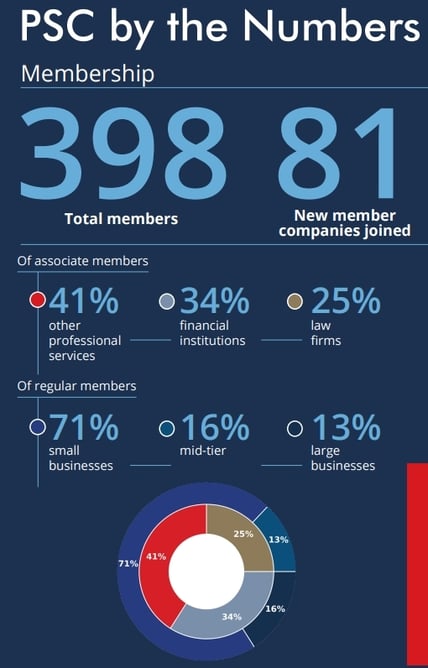
Last year we welcomed over 80 new members, and I look forward to working with all of you to continue to grow our association.

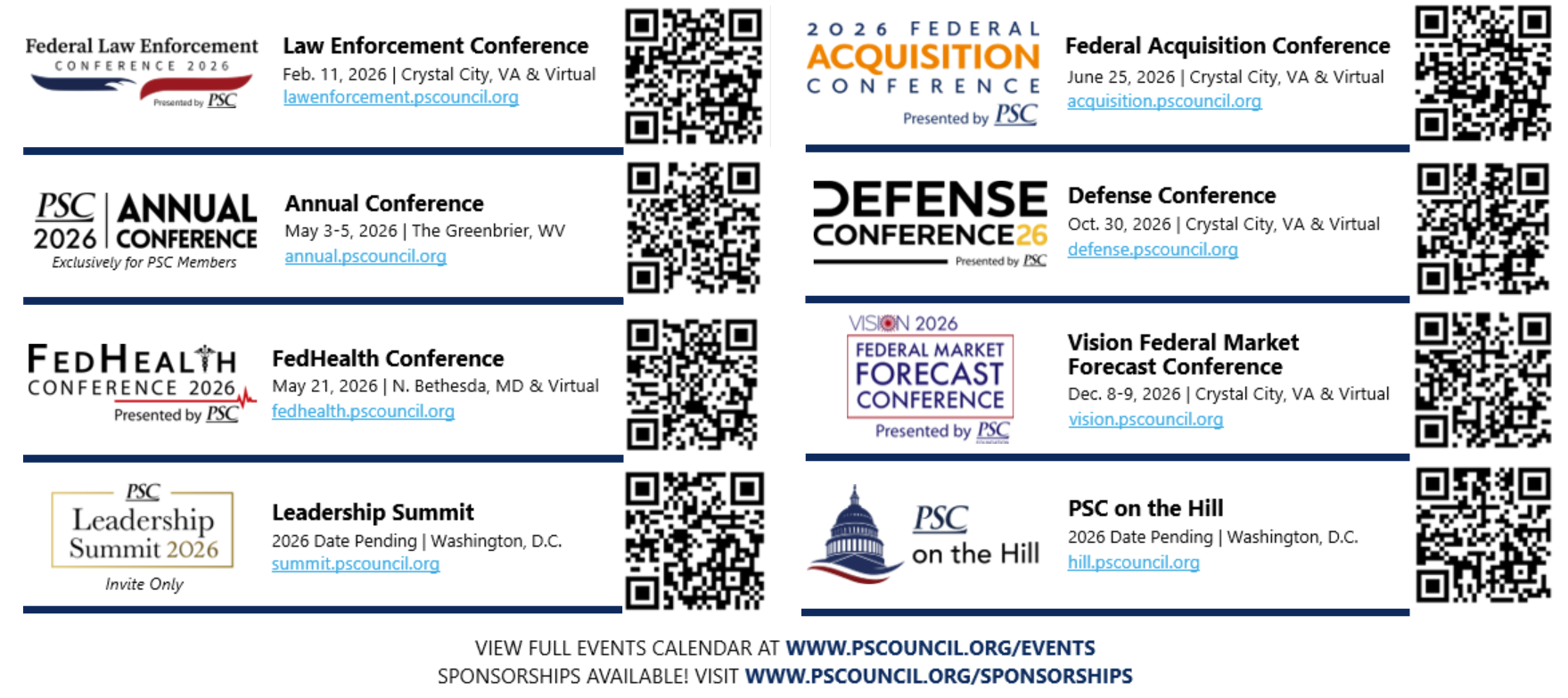
We already have an impressive lineup of events on the calendar including the Federal Law Enforcement Conference (Feb. 11), our member-exclusive Annual Conference (May 3-5), PSC on the Hill (March 24), FedHealth Conference (May 21), Federal Acquisition Conference (June 25), Defense Conference (Oct. 30), and Vision Federal Market Forecast Conference (Dec. 8-9). We are also launching PSC in the Field, an opportunity for members to meet government officials at onsite locations.

As we look ahead to 2026, PSC will continue to serve as your trusted partner, helping you to thrive in the federal contracting landscape.

I look forward to our continued partnership. We are advancing together.

Sincerely,
Screenshot 2026-02-02 211240
James Carroll, CEO, PSC


I want to extend my sincere gratitude to PSC members for your involvement and contributions. Our accomplishments, highlighted in this report, are a direct reflection of your active engagement with us to identify and address industry challenges and solutions. We are advancing together.

I also want to thank PSC’s leadership. First and foremost, thank you to our Executive Committee and Board of Directors, led by outgoing Board Chair Zach Parker, for their direction and support. Our new Board Chair John Heller and I are already working together to deliver results to PSC Members this year.

A special thank you to PSC staff for their dedication and hard work throughout 2025 and into 2026. And the collaboration and contributions by our President Stephanie Kostro have been instrumental to our success.

Last year we welcomed over 80 new members, and I look forward to working with all of you to continue to grow our association.

We already have an impressive lineup of events on the calendar including the Federal Law Enforcement Conference (Feb. 11), our member-exclusive Annual Conference (May 3-5), PSC on the Hill (March 24), FedHealth Conference (May 21), Federal Acquisition Conference (June 25), Defense Conference (Oct. 30), and Vision Federal Market Forecast Conference (Dec. 8-9). We are also launching PSC in the Field, an opportunity for members to meet government officials at onsite locations.

As we look ahead to 2026, PSC will continue to serve as your trusted partner, helping you to thrive in the federal contracting landscape.

I look forward to our continued partnership. We are advancing together.

Sincerely,

Screenshot 2026-02-02 211240
James Carroll, CEO, PSC

Letter from the President

159256_25597 (1)

It has been an honor to serve as PSC’s President since June 2025, taking the helm alongside CEO Jim Carroll to help lead the truly premier trade association for federal contractors. This Annual Report highlights many of the team’s amazing achievements over last year, and with your steadfast support and candid feedback, we are excited to tackle 2026 with energy, expertise, and purpose on behalf of our dynamic industry.

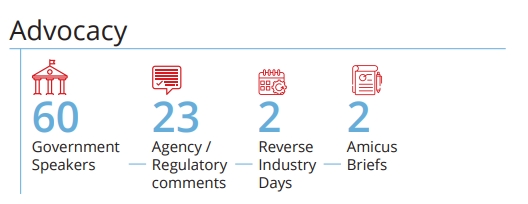
Of particular note, PSC’s engagement resulted in real collaboration with key Administration and Congressional officials on policy developments. From submission of 23 written comments to small-group meetings with key federal leaders, PSC gave voice to our industry on timely issues of high relevance and import to the federal marketplace. PSC’s policy lines of effort (here) guided our active work with senior policymakers, regulatory officials, and industry leaders. Learn more about the achievements of PSC’s five policy Councils by clicking here.

Our government relations efforts 
strengthened excellent communications with Congressional leaders and staff and shaped 
pivotal legislation, including but not limited to the defense authorization bill. Review these 
accomplishments on page 21, and priorities for 2026 can be found on here.

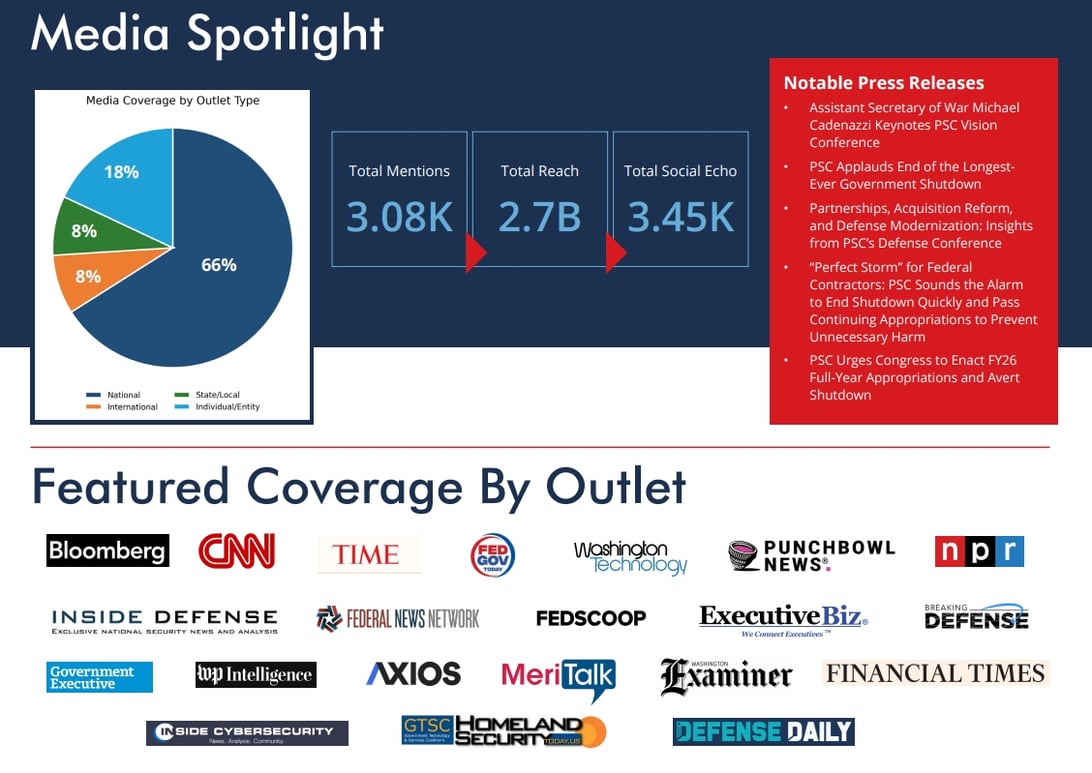
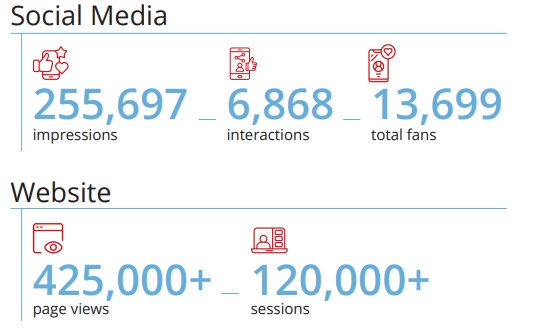
PSC’s media coverage increased 34% in 2025, and our social media engagement rose more than 140% year over year. This success has only amplified the value that government contractors bring to our federal partners and the American people. PSC’s media recap is here.


The PSC Foundation’s Vision Federal Market Forecast Program produced 20+ reports on the defense, civilian, and IT markets through a 10-month process involving some 450 industry volunteers, as well as hundreds of discussions with government leaders, think tank experts, congressional staff, and Wall Street analysts. Learn more here.

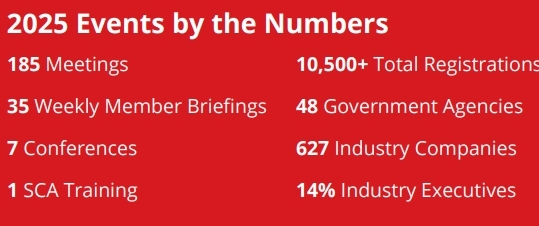
PSC hosted nearly 200 events and meetings this year, such as the Acquisition, Annual, Defense, FedHealth, Law Enforcement, Leadership Summit, and Vision Federal Market Forecast conferences. We also held a very successful PSC on the Hill event to showcase member companies’ border-related technologies and solutions. Additional details are available here.

The addition of 81 companies as PSC members underscored the value of membership. View PSC’s member list on here.

Finally, we could not accomplish our work without our active members and our year-long, events, and other sponsors (here). Thank you.

In the year ahead, we look forward to further strengthening our government-industry partnerships and are confident that, as we move forward together, we will only add to our successes on behalf of the federal contractor. 

Sincerely,

Screenshot_2-2-2026_213538_

Stephanie Sanok Kostro, 
President, PSC


The PSC Foundation’s Vision Federal Market Forecast Program produced 20+ reports on the defense, civilian, and IT markets through a 10-month process involving some 450 industry volunteers, as well as hundreds of discussions with government leaders, think tank experts, congressional staff, and Wall Street analysts. Learn more here.

PSC hosted nearly 200 events and meetings this year, such as the Acquisition, Annual, Defense, FedHealth, Law Enforcement, Leadership Summit, and Vision Federal Market Forecast conferences. We also held a very successful PSC on the Hill event to showcase member companies’ border-related technologies and solutions. Additional details are available here.

The addition of 81 companies as PSC members underscored the value of membership. View PSC’s member list on here.

Finally, we could not accomplish our work without our active members and our year-long, events, and other sponsors (here). Thank you.

In the year ahead, we look forward to further strengthening our government-industry partnerships and are confident that, as we move forward together, we will only add to our successes on behalf of the federal contractor. 

Sincerely,

Screenshot_2-2-2026_213538_

Stephanie Sanok Kostro, 
President, PSC


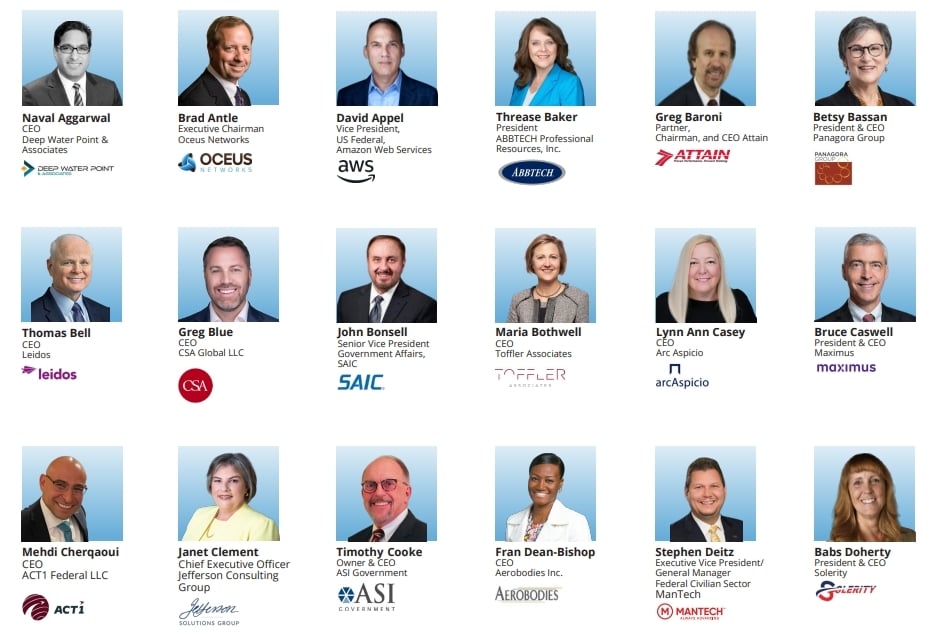
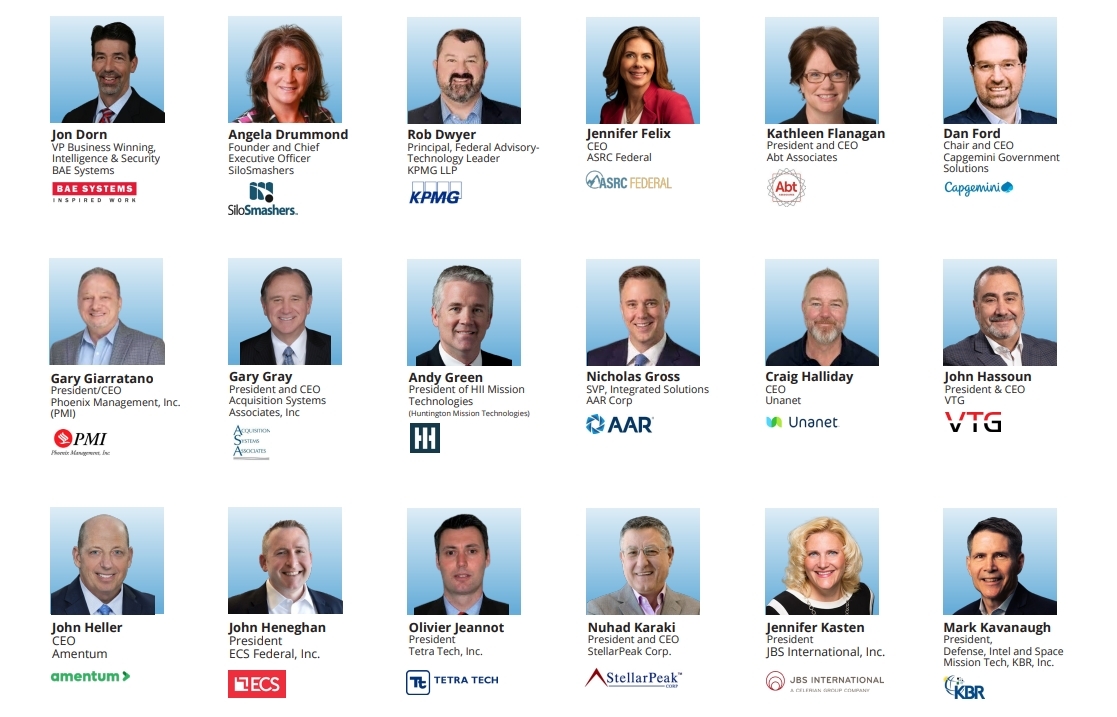
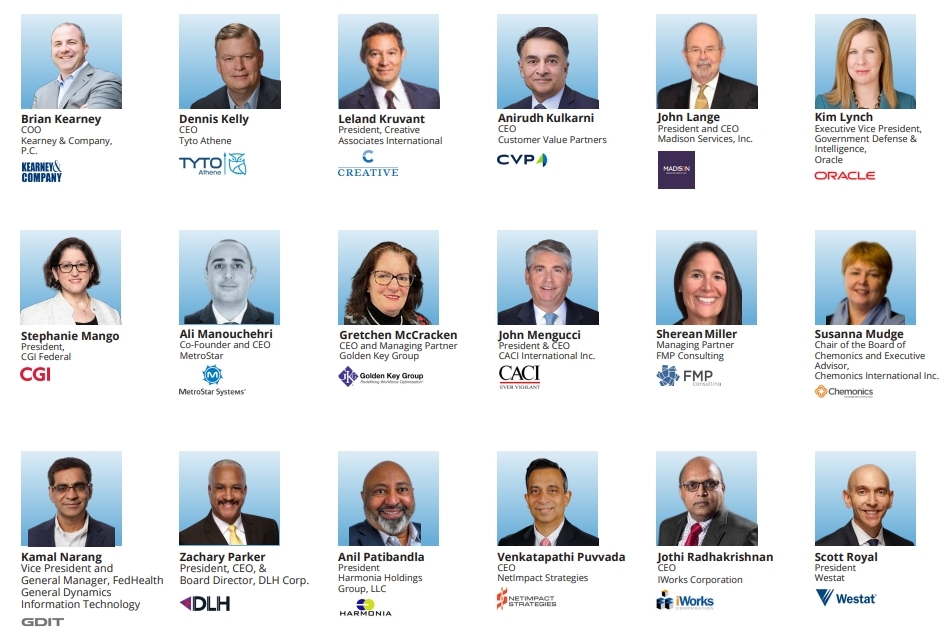
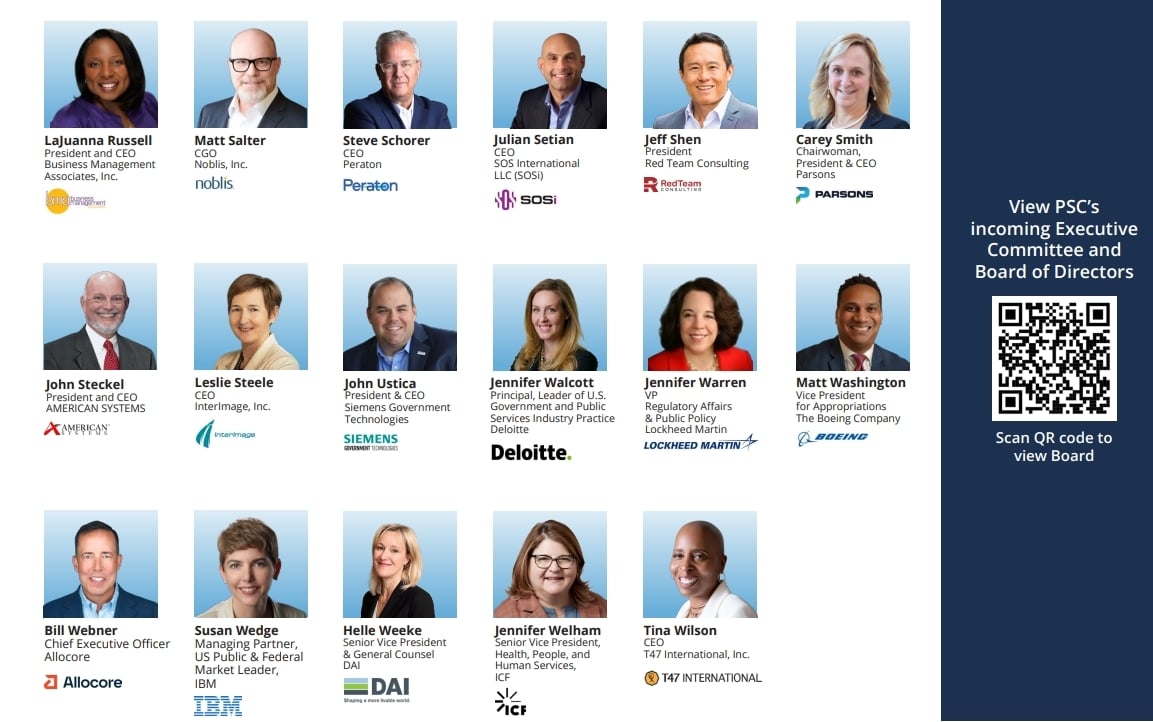
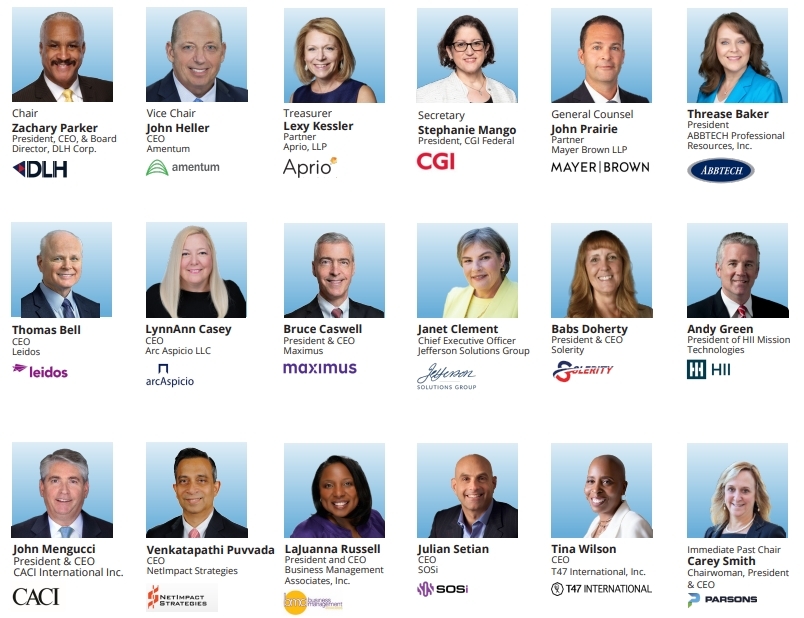
Executive Committee

Screenshot_4-2-2026_123144_
Email Banner (800 x 500 px)-1

Board of Directors

Screenshot_4-2-2026_123224_
Screenshot_3-2-2026_8241_
Screenshot_4-2-2026_123958_
Screenshot_3-2-2026_8643_

Mission and Priorities

PSC's mission is to provide unparalleled value to our members as the leading advocate and resource for the federal government contracting industry, tirelessly pursuing excellence and providing PSC member companies with: 

Unrivaled Advocacy and Policy Leadership

Outstanding Market Intelligence and Policy Insights

Value-Added Executive Events and Networking

Branding and Thought Leadership

PSC Priorities

Promote and Show the Value of Government Contracting and Contractors

Help the Government Become a Smarter Customer and Better Buyer and Improve Acquisition Outcomes

Support Technology Modernization and Innovation through Contracts

Act to Support Workforces Needed to Meet Future Government Missions

Maintain PSC as a Value-Added Association for Its Members

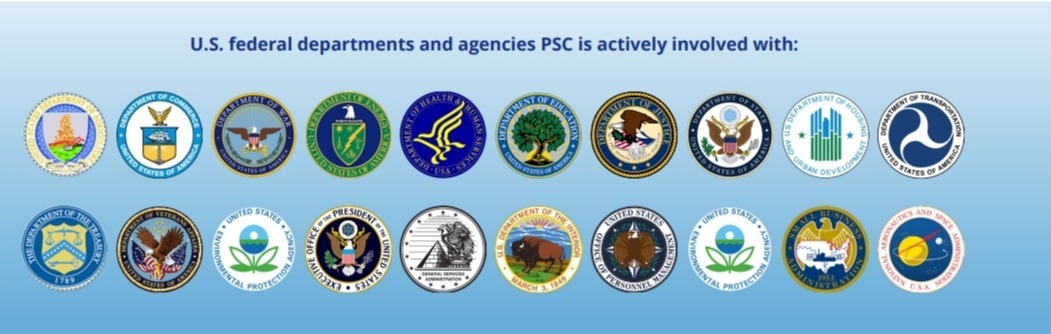
Key Issue Areas & Agency Involvement


PSC FOCUSES ON THE BELOW ISSUE AREAS ON BEHALF OF OUR MEMBERS:

Acquisition and Business Policy

Appropriations and Budget

Congress and Legislative Affairs

Cybersecurity

Ethics and Compliance (accounting, audits, reports)

Federal Health

Federal Law Enforcement

Workforce and Labor

Industrial Base and Competition

International Programs

Security Clearances and Public Trust

Small Business and Partnering

Supply Chain

Technology and Innovation

Screenshot_30-1-2026_132131_-1

Mission & Priorities - 2025 Sucesses

  • As the new Administration under President Trump sought to implement ambitious and wide-ranging initiatives to find cost efficiencies throughout the government, PSC worked closely with companies to highlight the critical role that contractors provide in advancing federal missions. This was particularly important as efficiency efforts targeted consulting, advisory and assistance, systems integration, and other areas of high relevance to services and solutions communities and as the U.S. Agency for International Development was absorbed into the U.S. Department of State.

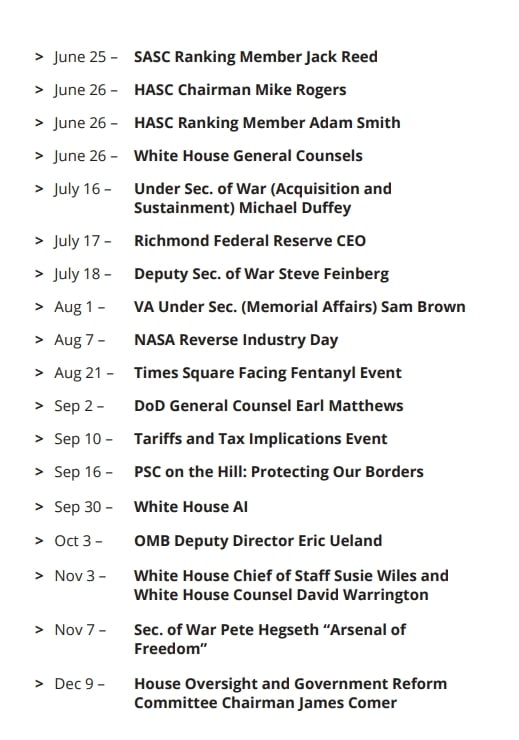
  •  Throughout 2025, PSC staff established and maintained excellent communications with key Administration officials, including but not limited to focused, member involved meetings with the  White House Chief of Staff, White House Counsels Office, Office of Management and Budget, and high-ranking agency officials (e.g., Deputy Secretary of War).

  •  During the longest-ever federal government shutdown in U.S. history, PSC frequently surveyed its member base and agency contingency plans to analyze the short and  longer-term impacts on federal missions, as well as on companies’ financial stability and workforce resilience; PSC urged swift actions to restore appropriations through letters to congressional leaders and White House officials that highlighted specific examples of harm from these impacts.

  •  PSC provided scores of media interviews on issues of highest interest to contractors and government customers alike, such as business and mission impacts of efficiency initiatives, appropriations lapses, preferences for commercial products and commercial services, ownership of intellectual property and technical data rights, and audits and investigations. Key tools created by PSC to help shape a compelling narrative on each issue were the Revolutionary FAR Overhaul Action Center, Government Funding and 
    Shutdown Resource Center, and a created Shutdown@ pscouncil email address through which members could  submit anecdotes, data, and other information to help the government understand real-world impacts. 

  • PSC officials met with congressional leaders, including  those elected officials who represent National Capital Region constituencies and the leads of both House and Senate Armed Services Committees. PSC also provided the latter with  written comments on the National Defense Authorization Act for Fiscal Year 2026 and issues such as: Streamlining Procurement for Effective Execution and Delivery (SPEED) Act, which sought to eliminate long-standing barriers to efficient acquisition and competition at the Department of War; proposed changes to contractor performance ratings; and limits on procurement of professional services that would create market distortions and impede market entrants.

  •  Despite a marked slowdown in the government’s rulemaking activity in the Federal Register, PSC provided 23 sets of written comments. Topics ranged from heat injury and illness prevention for the Occupational Safety and Health Administration to the then Department of Defense’s progress payment incentive pilot, from controlled unclassified information to preventing organizational conflicts of interest in federal acquisition. For each submission, PSC leveraged member company input and insights to ensure that observations were fair and recommendations were reasonable, much to the appreciation of industry and government colleagues alike.

  • PSC feedback proved instrumental as the Administration began to implement its Revolutionary FAR Overhaul, including but not limited to written comments and roundtable discussions on topics like:

    • “Rule of Two” (FAR Part 19 – Small Business) and small business consideration (FAR Part 10 – Market Research);
    • “Best-in-class” and preferred contracts (FAR Part 8 – Required Sources of Supplies and Services); 
    • Reasonable inflation adjustments (FAR Part 31 – Contract Cost Principles and Procedures); 
    • Role of protests as an important mechanism to hold government agencies accountable for acquisition performance (Part 33 – Protests, Disputes, and Appeals); 
    • The need to broader “enhanced debriefing” practices (FAR Part 15 – Contracting by Negotiation)
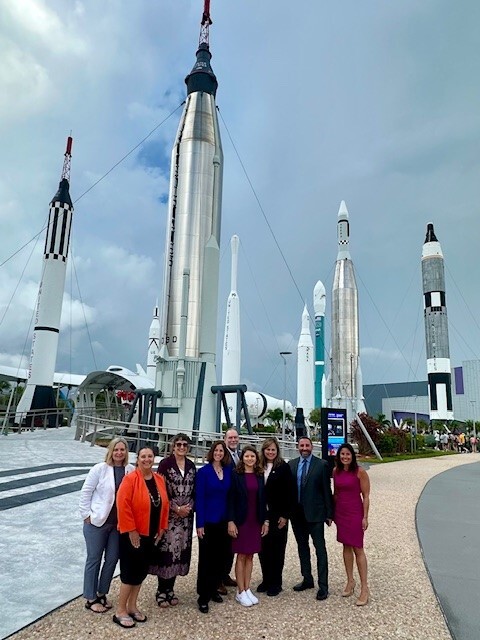
  •  PSC also organized two widely acclaimed “Reverse Industry Days” for NASA regarding go/ no-go considerations for potential bidders, requirements and evaluation criteria, and the role of industry engagement in attracting investment, incentivizing competition, and improving contract outcomes.

NASA2
  •  Throughout 2025, the government sought public and industry input on its efforts to leverage emerging technologies, especially artificial intelligence (AI), software, and cloud computing capabilities, for the benefit of American taxpayers. 

  •  A key element of this PSC effort was regularly held member meetings that allowed industry experts to raise concerns, questions, and ideas that PSC could  easily (and without attribution to a particular company) convey to government interlocutors.

  •  On AI, PSC led industry advocacy on the U.S. Government’s policy development through several discussions (e.g., with White House officials) and extensive comments to the Office of Science & Technology Policy and National Science Foundation on the government’s AI Action Plan, AI research and development  strategic plan, and regulatory reform on artificial intelligence.

  •  PSC also highlighted key considerations for the Department of War’s Software Fast Track (SWFT) initiative, reflecting several insightful comments provided  by a range of PSC member companies on software tools, external assessment methodologies, and automation and AI.

  •  In addition, PSC communicated several actionable recommendations to the Department of War regarding improved, efficient, and accelerated modernization of defense acquisitions and ways in which to incentivize faster, more targeted innovation in the nation’s defense industrial base.

  •  Throughout 2025, various forces caused immense strain on the contractor workforce that provides world-class, mission-essential services and solutions to federal departments and agencies. Such forces included, but were not limited to, the Administration’s efficiency initiatives (e.g., Department of Government Efficiency reviews, GSA “scrubs” of various contracts) and the 43-day federal government shutdown. In large part due to stop work orders, contract terminations, and lack of appropriations, some contractors had to furlough, or even terminate the employment of, American workers.

  •  This put a premium on PSC’s ability to communicate the latest-breaking information to its members. From February through December, PSC staff provided 35 member briefings – often referred to as “PSC’s Tuesday briefs” to share current developments in priorities, policies, and processes and up-to-date business intelligence. 

  • These briefings allowed company leaders to understand how government actions were impacting industry and how they could pivot to protect their valued, valuable workforce

  •  PSC also advocated for pay reimbursement after federal shutdowns, not only for federal workers but also for contractor personnel. This included support for key legislation sponsored by Sen. Chris Van Hollen (D-MD) and others. 

54484850966_e1c3c619e6_o
  • Supported a strong membership adding over 80 new members, totaling more than $600K in new member dues while maintaining a retention rate of 90%.

  • Produced 185 conferences and events designed to engage members across a wide spectrum of topical and agency areas in PSC’s scope.

  • Initiated and delivered on more than $800K in Annual Partnerships, an 18% YoY increase

  • Conducted 40 Member-wide member briefings on key trends impacting member success within agencies, including frequent insights, specific to the Government Shutdown between, October 1 and November 12.

  • Conducted 35 customized Market and Policy Briefings to inform members with tailored insight into spending and policy activities. 

  • Developed and implemented tools so PSC and members alike could track company engagement with PSC.

  • Improved member ability to join and renew online through improvements to the database and web site.  

  • Distributed Member Engagement Reports to members to relay value and encourage organizational participation. 

  • Amplified the visibility of PSC’s advocacy through communications, social media and general member outreach.

  • Hosted quarterly member engagement sessions and more than 50 individualized 
    engagement meetings.  

  • Secured in-kind partnerships valued at approximately $100,000. 

Untitled design (17)

PSC by the Numbers

Screenshot_1-2-2026_183221_


Government Relations Spotlight

Key Accomplishments


National Defense Authorization Act (NDAA):

  • FY2026 NDAA was signed into law on December 18
  • PSC was integral in working with committee staff and across associations to advocate for member issues
  • PSC was the leading voice on issues related to the non traditional contractor definition which was ultimately not changed in the final version

Security Clearance Reform

  • PSC leads a coalition of associations (AIA, INSA, NDIA) in meetings with HASC, SASC, HPSCI, SSCI, and DCSA staff regarding legislative priorities
  • The coalition was able to secure a provision that would look into increasing the eligibility for separated employees with clearances to not have to go through a full background investigation again if they return within 
    a 5 year period rather than the current 2 year period

Key Priorities for 2026


IT Modernization Reform

  • Planning PSC roundtable with Rep. Walkinshaw to discuss IT 
    modernization 
  • Continue to work with GSA on potential legislative changes to the 
    Technology Modernization Fund (TMF)
  • Quarterly meetings/events on IT modernization in 2026
  • House Select Committee on China.

Other Items of Interest

  • Regular meetings to discuss “Emerging 
    Large Business,“ how to leverage FY2026 
    NDAA acquisition reforms
54791758028_662bd9710a_c
54794556924_721363bfce_c
54791495366_df7dce0bb3_c
54791757993_95549c522b_c (1)
54791885288_33ba682968_c
54791957935_681aa91f79_c
54791885348_cb6a9ed671_c
54791885363_281019c7e4_c
54790780812_ea87bd46b1_c
54792133043_0e7082ae10_c

PSC Policy Lines of Effort

Cost of Doing Business with the Federal Government

Competition and Growth

Workforce

Technology, Innovation, and Modernization

Supply Chain and Logistics

PSC Council Spotlight


Untitled design (7)

Acquistion and Business Policy Council

ABPCThe Acquisition and Business Policy Council (ABPC) is the principal body for developing PSC’s policy positions and mobilizing action on major contracting initiatives across the U.S. federal government, including but not limited to White House initiatives that impact contracts and contractors such as the Revolutionary FAR Overhaul and the General Services Administration’s OneGov Strategy, deregulation efforts, FAR Council and other rulemaking activities, and government -wide acquisition contract vehicle processes. 

Key Achievements

  • Despite a government-wide pause on formal rulemaking via the Federal Register, submitted 23 sets of comments on a wide range of policy and procedural issues of high relevance and interest to the ABPC. These included policy and other changes such as the Revolutionary FAR Overhaul, software acquisition, worker safety, organizational conflicts of interest, controlled unclassified information, artificial intelligence, and cybersecurity.

  • Planned and executed a successful PSC Federal Acquisition Conference that featured timely, relevant speakers on GSA contract consolidation, the Revolutionary FAR Overhaul, supply chain risk management, supply chains and information technology, and industry impacts of executive actions.
  • Through the Mid-Sized Company Working Group and Contracting Working Group, successfully articulated how best to create an environment for business growth in responding to the U.S. Small Business Administration’s requests for comment on subcontracting programs, small business participation on certain multiple-award contracts, and small business size standards (monetary-based industry size standards).
  • Held scores of informative briefings for member companies on termination settlement proposals, stop work orders, contract review processes, and other efficiency initiative-related developments.
  • Established or refreshed three resource centers,
    including:
    •  PSC’s Post-Election Resource Center
    •  PSC’s Revolutionary FAR Overhaul Action Center
    •  PSC’s Government Funding and Shutdown Resource 
      Center
  • In late 2025, announced an ad hoc Business and Industrial Development Working Group that will last throughout 2026 with a focus on key factors to support companies’ resilience and growth in the federal marketplace – e.g., portfolio diversification, access to capital (cash flow, loan agreements). This group will identify all avenues of support for PSC members to thrive in the evolving contract landscape.
Committees/Working Groups
2026 Agenda
  • Help revise the Federal Acquisition Regulation and agency supplements to empower federal acquisition and 
    contractor workforces
  • Assess, and make targeted recommendations to demonstrably 
    improve, federal procurement forecasting
  • Produce a comprehensive and actionable Acquisition Policy Survey
  • Identify policies, regulations, and trends that diminish the 
    industrial base (e.g., disincentivize contractors from staying in the 
    federal market, discourage new entrants) and seek value-added 
    ideas about how best to support resilience and growth
  • Ensure fair access to “Best-in-Class” or “required use” contracts in 
    fair and open competition and promote standards for frequent 
    on-ramping for longer-term contracts
  •  Offer forums to share business intelligence and growth ideas
2025 Executive Advisory Board
  • Tim Cooke -- ASI Government
  • Heidi Gerding -- HeiTech Services, Inc.
PSC Staff
Untitled design (8)

Civilian Agencies Council

CACThe Civilian Agencies Council (CAC) focuses on acquisition policies and strategies of the full range of civilian agencies, including but not limited to the departments of Energy (DoE), Health and Human Services (HHS), Homeland Security (DHS), and Veterans Affairs (VA). The CAC's programs inform members about civilian agencies’ policies and initiatives, serving as an interactive forum to improve dialogue, transparency, and information exchanges between PSC members and federal government officials. CAC priorities include:

  • Serve as the primary forum to address impacts of acquisition policies, business practices, and strategies on federal civilian agencies' markets.
  • Share private sector expertise and knowledge to improve business practices, models of engagement, technology acquisition, culture, and management policies in support of government mission outcomes and citizen services.
  • Build strong, collaborative relationships between government officials and the PSC member community.
  • Support efforts to reduce government practices that stifle innovation, competition, speed, and/or efficiency in procurements.
  • Position members to understand the future direction of civilian agencies’ marketplaces.

Key Achievements

  • Helped our members understand and navigate the unprecedented changes to civilian agency contractors through task force meetings, briefings, communication updates, and analysis of new executive orders and agency memos.
  • Shared industry impacts with key agency decision-makers and media on important matters affecting contractors (i.e., stop work orders, delays in invoice payments, contract review processes, layoffs, cash flow) as a result of efficiency initiatives, agency restructuring, and the government shutdown.
  • Facilitated two industry led training programs for program and acquisition officials for NASA HQ and NASA Kennedy Space Center. Members performed a mock role play demonstrating how companies make bidding decisions and shared perspectives on forecasts; requirements and evaluation criteria; and ways in which communication and engagement with industry can attract investment, incentivize competition, and improve contract outcomes.
  • Organized and held PSC’s 2025 Federal Law Enforcement Conference, bringing together nearly 300 industry and government officials. Government speakers hailed from DEA, ATF, FDIC, Homeland Security Investigations, NCMEC, and the White House to discuss the threat environment of the dark web, NextGen case management systems, and the Administration’s plans for border enforcement.  
  • Planned and executed PSC’s 2025 FedHealth Conference, which brought together more than 200 attendees from government and industry, including current and former officials from NIH, FDA, SAMHSA, DHA, GSA, SBA, HHS Office of Acquisitions, and the Senate and House Veterans Affairs Committees to discuss Congressional perspectives on Veterans health policy, the future of digital health, the new strategic direction of NIH and FDA, and FedHealth procurement trends.
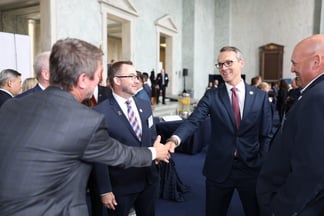
  • Held a successful PSC on the Hill event focused on border security technologies, welcoming members of Congress and their staff to meet with the Government’s contracting partners who are critical to achieving this vital mission set.
Task Forces
2026 Agenda
  • Understand new organizational structures, policy shifts, and key initiatives of the Administration and what they mean for the civilian marketplace
  • Continue building relationships between members with agency leadership, ensuring priorities and directives are commonly understood.
  • Emphasize to federal civilian agencies the important partnership role of government contractors in helping achieve Administration priorities in areas such as: digital transformation and IT modernization; border security; cybersecurity, space; energy expansion; science; and AI and other emerging technologies.
  • Engage with government decision-makers on the development of key contract vehicles that promote competition and support acquisition outcomes.
  • Lead Reverse Industry Day sessions to improve agency officials’ understanding of industry decision-making factors, the value of communication, and the implications of the FAR overhaul and other recent government actions on procurement.
  • Continue engagement and information sharing with DoE, HHS, DHS, VA, and other relevant agencies through task force meetings and programs.  
  • Ensure the 2026 Federal Law Enforcement and FedHealth Conferences are forums for value-added discussion on critical mission topics. 
  •  Lead an industry tour of CBP operations in San Diego and Los Angeles to help members better understand their operating environment and technology needs.
2025 Executive Advisory Board


  • Stephen Deitz -- ManTech
  • Larry Grossman -- TetraTech
  • Andrea McCarthy -- HARP
  • Francis Moody -- Serco
  • Todd Pantezzi -- Credence Management Solutions
  • Kelly Sutch -- CGI Federal
  • LaJuanna Russell -- Business Management Associates
  • Dave Stahlman -- Arc Aspicio
  • Kathy Taylor -- DRT Strategies
  • Elaine Turville -- Accenture Federal Services
  • Kirste Webb --  PQC Solutions
  • Jennifer Welham -- ICF
  • Stephanie Wilson -- NetImpact Strategies
PSC Staff
Screenshot_2-2-2026_114620_

Council of International Development Companies

CIDCThe Council of International Development Companies (CIDC) meets monthly to create a dynamic, sustainable engagement platform for U.S. development companies to pursue thought leadership and high-level dialogue with the U.S. Agency for International Development (USAID), Department of State, Millennium Challenge Corporation (MCC), President's Emergency Plan For AIDS Relief (PEPFAR), Development Finance Corporation, and other foreign assistance organizations. CIDC aims to educate audiences on the vital role international development companies play in achieving accountable, transparent and sustainable development results in support of U.S. national security, economic, and humanitarian goals overseas.  

This past year CIDC activities were significantly impacted by the Trump Administration’s decision to terminate the majority of international development contracts, disband the U.S. Agency for International Development (USAID), and move any remaining USAID functions into the U.S. Department of State.


Key Achievements

  • Drafted, revised, and sent a letter to Secretary of State Marco Rubio to request a reassessment of Stop Work Orders (SWOs) issued to USAID and State Department contractors engaged in international development work, as well as unpaid invoices for work already completed. Afterwards, PSC released this letter publicly to highlight that the government should compensate companies for work already performed under contract; the PSC press release noted that at the time, the government had some $500 million in unpaid invoices.
  • Working with CIDC members, maintained the only active database on the number of American staff downsized and outstanding invoices owed as a result of the stop work orders. This was information vital to briefing congressional members and staff, as well as the media.
  • Continued to work with remaining USAID staff to keep them apprised of contract dollars invoiced but unpaid; facilitated several key meetings on the subject.
  • Supported CIDC Executive Advisory Board members in Capitol Hill meetings – such as with House Armed Services Committee Ranking Member Adam Smith, who requested first-hand impact statements of the SWO on companies and U.S. foreign policy.
  • Assisted CIDC members in pivoting their work to the Department of State and other government agencies.
  • Ran regularly members-only working sessions on Termination Settlement Proposals, ensuring there was a not-for-attribution forum to share best practices, lessons learned, and other information to support timely submission and processing of TSPs for international development work.
Task Forces/Working Groups
2026 Agenda
  • Engage with Administration officials throughout the U.S. foreign assistance 
    enterprise, including  Millennium Challenge Corporation, Development Finance Corporation, Department of State, and others as appropriate to highlight CIDC members’ 
    capabilities, their vital role in American foreign policy, and the attendant value to the taxpayer.
  • Work with new Congressional officials—in both the U.S. Senate and House of Representatives—to increase understanding of, and appreciation for, CIDC member issues and concerns. 
  • Identify, analyze, and make recommendations regarding the impact of policies, processes, statutes, and regulations related to new administration priorities (e.g., funding and personnel adjustments, policy changes that may impact federal contracts).
2025 Executive Advisory Board

Chair: Mark Johnson -- TetraTech International Development Services

Vice Chair: Torge Gerlach, DT Global

  • John Gastright -- Amentum
  •  Christopher Scott -- Chemonics
  • Leland Kruvant -- Creative Associates
  • Jeremy Kanthor -- DAI
  • Kathleen O'Dell -- Deloitte
  • Raphael Romeu-- DevTech
  • Raoula Attar, Ecodit
  • Betsy Bassan -- Panagora Group
  • Earl Gast, URC
PSC Staff
Screenshot_2-2-2026_12230_

Defense and Intelligence Council

DEFThe Defense and Intelligence Council (D&IC) leads  PSC’s efforts with the intelligence community (IC), Office of the Secretary of War, military departments, and defense agencies. D&IC is the principal forum for PSC members to engage with government decision-makers and provide input on acquisition policies and programs within the defense and intelligence spaces.

Key Achievements

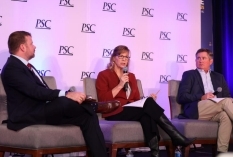
  • Planned and hosted PSC’s 2025 Defense Conference, featuring Representatives Scott Franklin, James Walkinshaw, and Rob Wittman along with HASC Professional Staff Members, and key leaders from the defense industrial base. This year’s conference focused on Thriving Through Transition: Building Resilient, Forward-Looking Solutions and spotlight agility, efficiency, and innovation across the national security ecosystem. Panel topics included: Working Together: Strengthening Partnerships Among Congress, DoD, and Industry; Unlocking and Implementing Commercial Solutions Across the Defense Ecosystem; Aligning Energy Demand and Investment for the Future Defense Industrial Base; and Impacts of the Funding Lapse on the Defense Industrial Base.
  • Orchestrated a meeting between the Office of the Secretary of War (OSW) for Industrial Base Policy and PSC member companies to discuss Executive Order 14265, Modernizing Defense Acquisitions and Spurring Innovation in the Defense Industrial Base, and provide feedback/input on acquisition workforce reform and cultural shift to take risk; increasing communication between OSW and industry about priorities to help inform investments; moving towards outcome-based contracts and performance-based solutions; small business concerns; and level playing field for competition.
  • Led and participated in International Defense Industry meetings to include a tri-country trade associations meeting in London prior to the Defence and Security Equipment International (DSEI) event where we jointly collaborated on a draft paper for the AUKUS Governments to help set expectations and establish next steps for AUKUS.
  • Submitted comments and recommendations on Executive Order 14265, Modernizing Defense Acquisitions and Spurring Innovation in the Defense Industrial Base  and on the Department’s Software Fast Track (SWFT) Tools RFI concerning how the Department obtains, evaluates, and approves secure software for use.
  • Participated in quarterly CODSIA meetings with Department acquisition professionals – these sessions are an interactive dialogue between PSC and defense components for improving industry-wide consideration of policies, regulations, implementation challenges, and questions around federal procurement actions.
  • Led Cybersecurity Working Group meetings throughout 2025 to include engagement with PSC’s Cybersecurity Working Group on IT issues and the CMMC Contract Clause Final Rule.
Committees
2026 Agenda
  • Defense Acquisition Reform: Working with Congress, DoD, and Industry 
    to streamline acquisition policies and processes (Use of AI in the acquisition 
    process; self-scoring; PPBE reform, etc.)
  • Innovation: Collaborating with DoD and the Intelligence Community to support 
    innovation for emerging requirements
  • Educating the Acquisition Workforce: Partnering with defense components 
    (e.g., DAU, NDU, and DSCU) on relevant, timely training materials and 
    opportunities (e.g., courses, reverse industry days)
  • CMMC Implementation: Engaging DoD and other officials on policies, 
    processes, and clauses related to CMMC requirements
  • Security Clearance Reform: Advocating for personnel vetting and facility 
    clearance reform with Congress and the Executive Branch
  • International Cooperation Working Group: Reinforcing the importance of 
    trusted industrial partnerships in shaping the future of defense for the trilateral 
    partnership (technology transfer)
2025 Executive Advisory Board
  • Waymon Armstrong -- Engineering & Computer Solutions (ECS)
  • Chris Bahret -- VTG
  • John Cooper-- AAR Corp
  • Mark Fialkowski -- Parsons
  • Tina Wilson -- T47 International
PSC Staff

  • Steve Harris, Vice President, Defense and Intelligence 
Untitled design (9)

Technology and Innovation Council

techinlogonewThe Technology and Innovation (Tech & Innovation) Council   is PSC’s principal arm for developing PSC’s positions and taking action on crosscutting technology issues, from cybersecurity and cloud computing to generative artificial intelligence technologies and tools to “as-a-service” acquisition and beyond. With technology issues increasingly permeating the professional services sector, the Tech and Innovation Council helps PSC members better navigate the market and policy landscape.  The Tech and Innovation Council engages in thought leadership and high-level dialogue with officials from federal government agencies and Congress on critical technology and innovation issues that could support existing and emerging U.S. Government requirements.

Key Achievements

  • Led PSC’s AI Roundtable and related Emerging Technologies Working Group meetings throughout 2025, convening members across industry to address evolving federal priorities on AI and emerging technology policy. Organized and facilitated discussions on the new administration’s AI priorities, including the federal AI Action Plan, OMB AI policy memos, and GSA acquisition strategies. Coordinated cross-group engagement with PSC’s Cybersecurity Working Group on IT issues and the CMMC Contract Clause Final Rule.
  • Developed and executed a leading panel on federal IT modernization at PSC’s 2025 Annual Conference, featuring former senior government IT executives in a high-impact discussion on modernization strategy and cross-sector collaboration.
  • Facilitated the launch of the first in a series of multi-association cloud discussions—with the Business Software Alliance and the Center for Procurement Advocacy—to engage industry on cloud and cloud acquisition challenges and to identify industry-driven solutions that enhance competition and accelerate outcomes in support of government missions.
  • Orchestrated a meeting between the Office of White House Counsel and PSC member company general counsels to address legal and regulatory challenges facing industry in advancing AI technologies within the federal environment.
  • Submitted comments and recommendations on two National Science Foundation RFIs—the AI Action Plan RFI and the 2025 revision of the National AI R&D Strategic Plan RFI—as well as the Office of Science and Technology Policy’s RFI on AI Regulatory Reform, the FAR Council’s proposed rules on CUI and cybersecurity workforce requirements and standards in federal contracts, and the Department’s Software Fast Track (SWFT) Tools RFI concerning how the Department obtains, evaluates, and approves secure software for use.
Working Groups/Roundtables

Technology and Innovation Council,
including a renewed focus on IT
Modernization in the federal context.


Cybersecurity Working Group,
including a focus on CMMC and post quantum encryption technologies.


Emerging Technologies Working
Group, including a focused group on
artificial intelligence and a new cloud
contracting initiative.

2026 Agenda

  • Advance Federal IT Modernization: Build on 2025 momentum by shaping
    recommendations on legacy modernization, Working Capital funding budgets,
    enterprise data, and secure cloud adoption.
  • Drive AI Policy and Implementation: Lead industry engagement on federal AI
    frameworks, procurement guidance, and responsible adoption.
  • Reform Cloud Contracting: Continue the multi-association initiative to improve
    cloud acquisition, focusing on competition and interoperability.
  • Monitor Cyber Readiness Requirements: Track implementation of CMMC,
    post-quantum encryption, and emerging federal cybersecurity standards to help
    contractors stay prepared.
  • Convene Cross-Sector Dialogues: Host recurring sessions with federal CIOs
    and PSC members on AI, data, federal business priorities and initiatives and
    cybersecurity alignment.
  • Influence Federal Tech Policy: Shape government action on software
    assurance, secure-by-design practices, and tech workforce development.
2025 Executive Advisory Board
Chair: Leslie Steele --InterImage
  • Brian Thamm -- Sophinea
PSC Staff

Key Programs

PSC 2025 Annual Conference


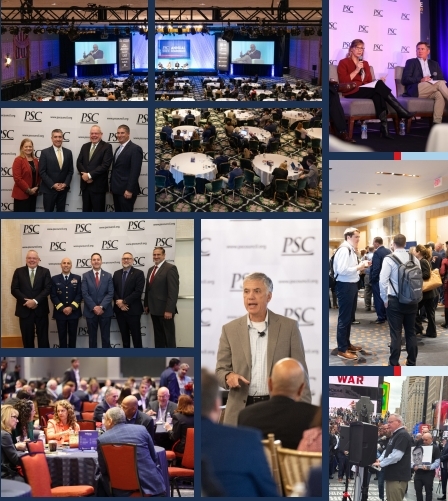
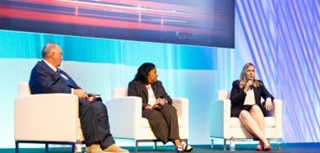
The PSC Annual Conference was the premier government contracting conference of 2025. Our attendees were joined by government and industry leaders that addressed current issues facing the government professional and technology services industry. They gained actionable insights over three days of networking and informational sessions
     

358 INDUSTRY & GOVERNMENT EXECUTIVES

 
Featured Speakers:
  • BG Leslie Beavers, Principal Deputy CIO, DOD
  • Bill Evanina, Founder and CEO of The Evanina Group, LLC, former Director of U.S. National Counterintelligence and Security Center
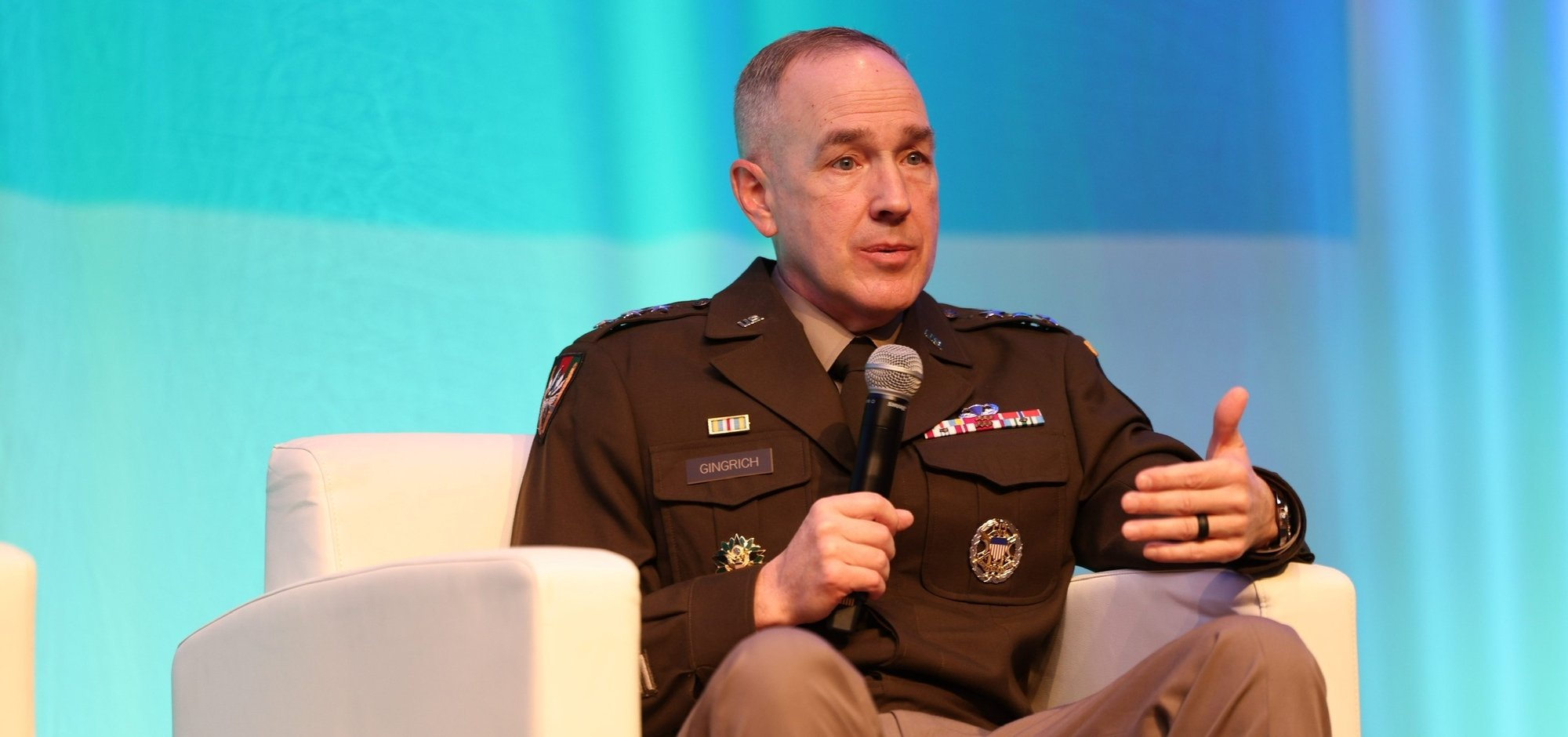
  • LTG Karl Gingrich, Deputy Chief of Staff, G-8, U.S. Army
  • Bridget Bean, Executive Director of the Cybersecurity and Infrastructure Security 
    Agency (CISA)

FedHealth Conference

FedHealth Logo - 150x150

The ninth annual PSC Federal Health Conference brought senior executives from across industry and government together to discuss critical industry policy and acquisition priorities in civilian and military health. Speakers from HHS, VA, and DoD discussed their needs and challenges so that industry can better determine where the federal health market is headed. This half-day conference was an opportunity to hear ideas from senior government and industry leaders in an extensive dialogue on federal health agencies, future policy and procurement trends and their implications on their company.

                    Screenshot_2-2-2026_143632_

232 INDUSTRY & GOVERNMENT EXECUTIVES

Keynote Speaker
  • Barclay Butler, COO, FDA

Defense Conference
Defense Logo All Black

The PSC Defense Conference brought together senior executives across the Department of Defense and industry to discuss current initiatives aimed at accelerating innovation and delivering capabilities to the Future Force.
                      Screenshot_2-2-2026_153921_

127 INDUSTRY & GOVERNMENT EXECUTIVES

Keynote Speakers
  • Congressman Rob Wittman,
    Representative from Virginia
  •  Congressman James Walkinshaw,  Representative from Virginia            

  • Congressman Scott Franklin, Representative from Florida
Web capture_25-1-2024_13466_pscouncil.sharepoint.com

PSC on the Hill

FINAL PSC on the Hill Evergreen Logo

This event at the U.S. Capitol was an opportunity for PSC members to showcase to Congress and their staff the work government contractors do in support of the U.S. border security mission. PSC invited Members and staff from the House Homeland Security Committee, the Border Security Caucus, and personal offices of both Committee and Caucus members.    

                                                  54791495366_97f6a89c80_o (1)-jpg


150 INDUSTRY & GOVERNMENT EXECUTIVES

 
  •    

Vision 2025 Federal Market Forecast Conference

                  Vision Conference Logo Color 2024

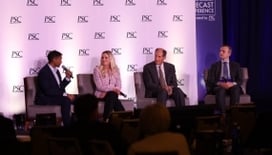
Presented by the PSC Foundation, the Vision Federal Market Forecast provides a compilation of more than 20 reports that provide in-depth analysis of the defense, civilian, and federal IT markets. The reports were a year-long culmination of research and non-attribution discussions with 400+ government leaders, think tank experts, Congressional staff and Wall street analysts conducted by a vetted and trained industry. The Vision Forecast is the only non-profit reporting of the defense, civilian, and federal IT markets. It is presented and organized by the PSC Foundation.
          Screenshot_2-2-2026_134756_

The PSC Vision program is driven by industry volunteers meeting with a wide range of industry experts.

21 Study teams covering Defense, Civilian and Government-wide topics

Over 450 industry volunteers, representing 175 federal contracting companies, contributed to this year's process

400 discussions held across the federal government 

334 INDUSTRY & GOVERNMENT EXECUTIVES


Featured Speakers:
  • Micheal Cadenazzi, Assistant Secretary of War, DOW
  • Donald R. Stakes, Acting Dep. Executive Assistant Commissioner, Office of Field Operations, Customs and Border Protection, U.S. Department of Homeland Security
  • Sean Fitzgerald, Assistant Director, Cyber and Operational Technology Directorate, Homeland Security Investigations
  • RADM Jason Tama
    Commander, US Coast 
    Guard Cyber Command, United States Coast Guard, U.S. Department of Homeland Security

Leadership Summit 2025
Leadership Logo All Black

The PSC Leadership Summit is an exclusive, invitation-only gathering of federal contracting executives that provides high-level networking and dynamic forums that helped set the PSC policy agenda for the year ahead. The Summit was comprised of the PSC Board of Directors and C-suite member executives. Leaders received closed-door updates from PSC executives, heard from high-ranking government officials, and provided feedback on issues that matter most to federal contracting.

Leadership Summit

89 INDUSTRY EXECUTIVES

Keynote Speakers
  • Paul Nakasone, Former Commander, U.S. Cyber Command & Former Director of the National Security Agency, Four-Star Army General (Ret.)
  • Admiral C. Grady, USN, Vice Chairman, Joint Chiefs of Staff
  • Congressman G. Ivey 
    (MD-04)

Federal Acquisition Conference
Acquisition Logo - 200x200

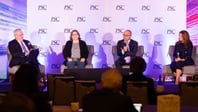
Acquisition leaders from across government agencies discussed key emerging acquisition trends and initiatives in their respective organizations, as well as those with government-wide impacts. This conference brought together business development, proposal development, and contracts compliance officials within industry.                                     
                           Screenshot_2-2-2026_151710_

187 INDUSTRY & GOVERNMENT EXECUTIVES

Keynote Speakers
  • Stacy Bostjanick, Chief Defense Industrial Base Cybersecurity, Office of the DoD Chief Information Officer, DoD
  • Larry Allen, Associate Administrator Governmentwide Policy and Chief Acquisition Officer, GSA

Federal Law Enforcement Conference

Change Size

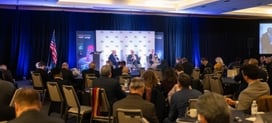
The PSC Federal Law Enforcement Conference brought senior executives from across industry and government together to discuss key law enforcement initiatives. Given the administration’s focus on law enforcement and security, this was an opportunity for industry to engage with key government executives on law enforcement challenges. Speakers from DHS, DOJ, and other law enforcement agencies discussed their priorities and industry leaders discussed where the market is headed. 
             Screenshot_2-2-2026_152447_

305 INDUSTRY & GOVERNMENT EXECUTIVES

Keynote Speakers
  • Mike Maxwell, Special Agent in Charge, Office of Investigative Technology, DEA
  • Tom Homan, White House Border Czar

2026 Featured Events

Screenshot 2026-02-03 124333

Year in Review: Featured Meetings and Events

Screenshot_3-2-2026_123735_

Year in Review: Membership Numbers

Email Banner (10)

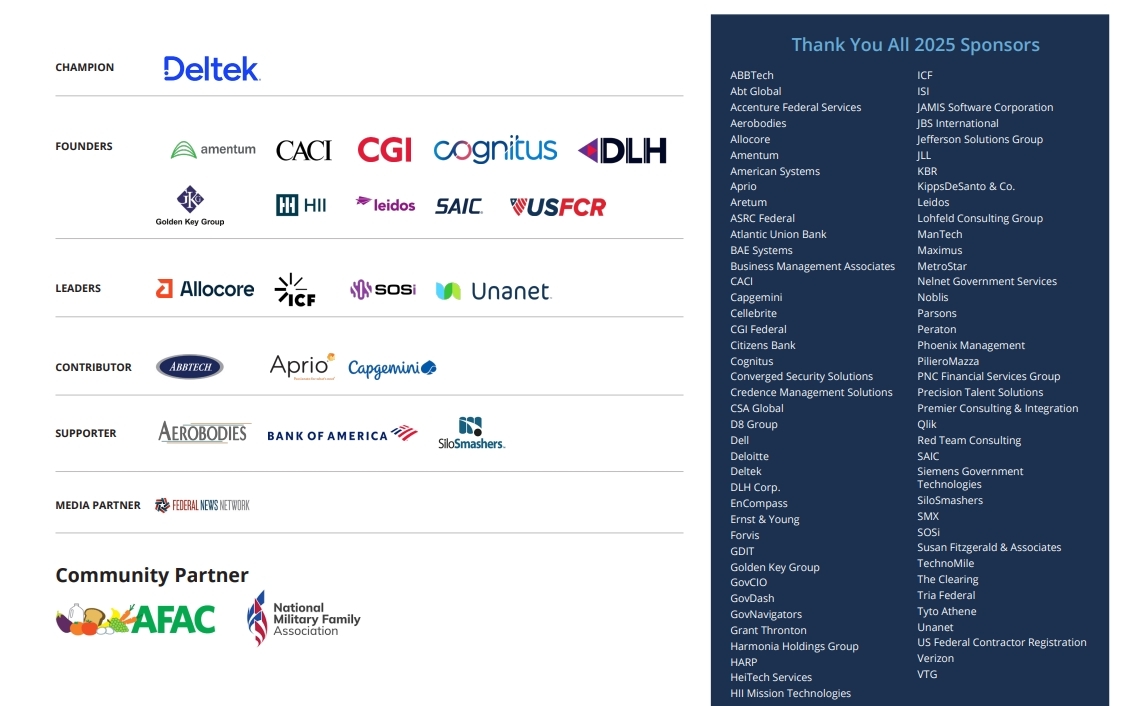
THANK YOU 2025 YEAR-LONG PARTNERS!

Screenshot_2-2-2026_131254_

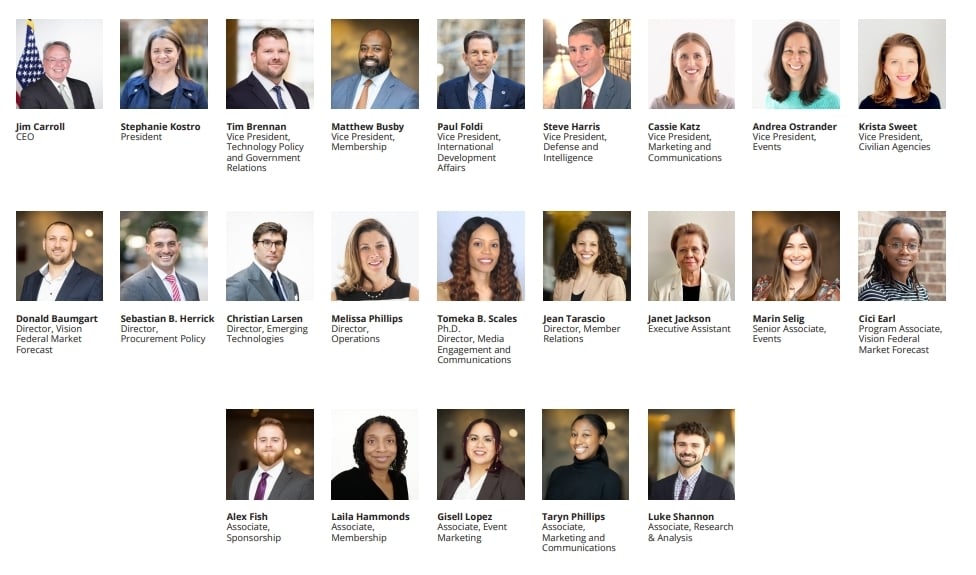
PSC Staff

PSC logo 2