

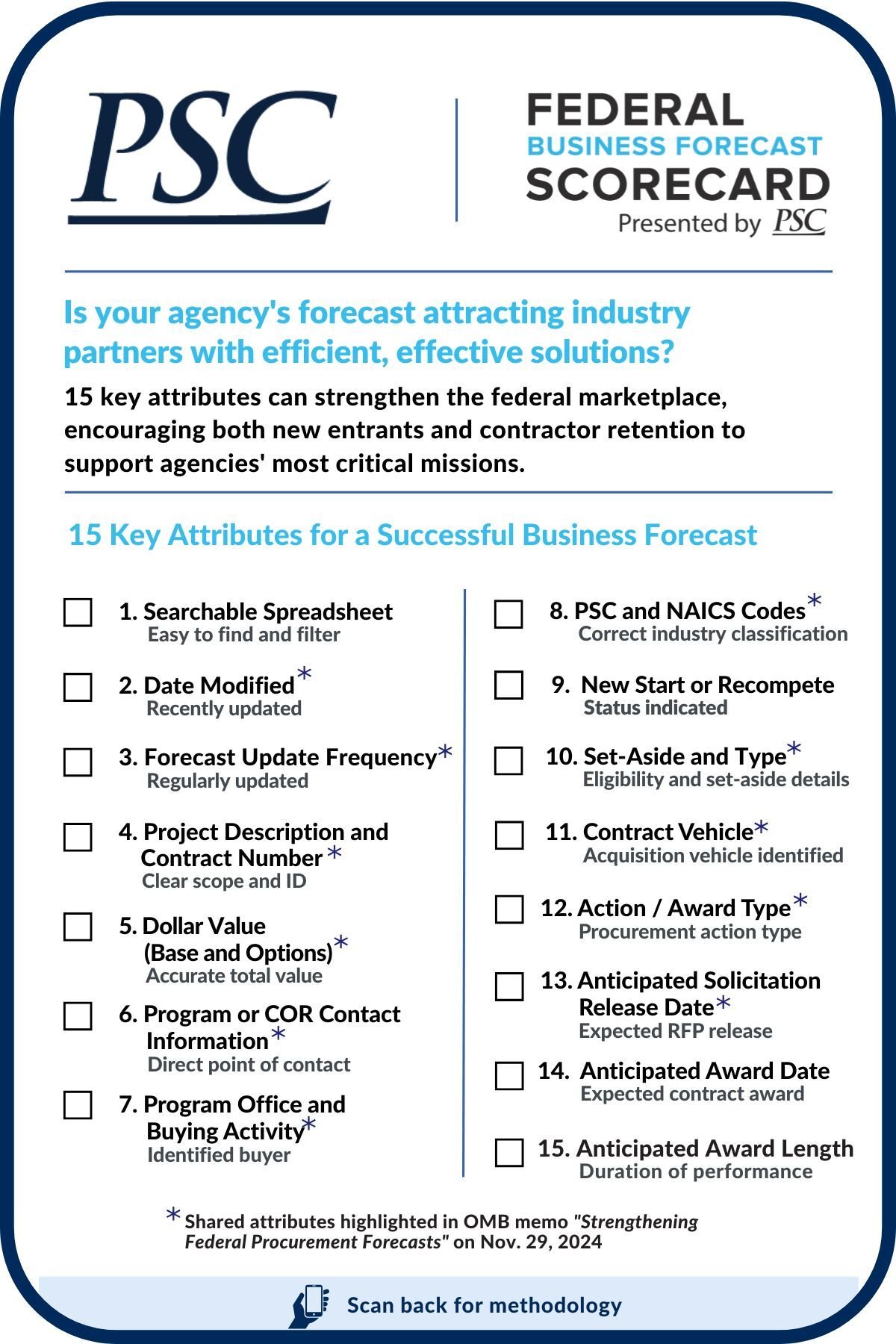


Searchable Spreadsheet
Easy to find and filter
At a minimum, forecasts should be available in Excel format. Because PDFs…
Easy to find and filter
At a minimum, forecasts should be available in Excel format. Because PDFs are often difficult to read and sort, it is also difficult to extrapolate data; this complicates a potential bidder’s ability to identify opportunities. The use of a PDF may also indicate that the agency does not frequently update the forecast. PSC’s Federal Business Forecast team awards additional points for advanced Electronically Sortable Information (ESI) systems which go above and beyond Excel.
Why this matters: Excel or an ESI format allows industry to easily search for and organize opportunities and allows agencies to update forecasts more easily.

Date Modified*
Recently updated
Agencies should indicate the last modification date for each opportunity. This…
Recently updated
Agencies should indicate the last modification date for each opportunity. This informs users whether the information is recent or has changed since last viewing.
Why this matters: Without a date modified, contractors may be uncertain if information has changed. When uncertain, potential bidders spend additional resources on inquiries to determine relevancy and timeliness of information provided; since respondents to these inquiries are most often government officials, this also creates additional work for agencies.

Forecast Update Frequency*
Updated on a regular Basis
PSC’s Federal Business Forecast team evaluates forecasts on frequency of…
Updated on a regular Basis
PSC’s Federal Business Forecast team evaluates forecasts on frequency of publication. Agencies should update procurement forecasts at least twice a year.
Why this matters: Potential bidders may lose confidence in the forecasting tool’s accuracy and efficacy if information appears outdated. They are less likely to expend resources for proposal preparation, possibly reducing competition for an agency’s opportunities.
Project Description and Contract Number*
Clar scope and ID
The PSC team evaluates forecasts on the existence and comprehensiveness of a…
Clar scope and ID
The PSC team evaluates forecasts on the existence and comprehensiveness of a project description and if the agency has assigned a contract number to the opportunity. To the greatest extent practicable, forecasts should include details on place of performance, type and scope of work, technical requirements, potential security clearance requirements, and other relevant opportunity-specific information.
Why this matters: With a more detailed description of the work required, companies can determine if an opportunity fits their capabilities, requires teaming, and is a good use of their resources to track and pursue.

Dollar Value (Base + Options)*
Accurate total value
The PSC team evaluates forecasts on whether the tool lists…
Accurate total value
The PSC team evaluates forecasts on whether the tool lists opportunity-specific dollar values, as well as the specificity of dollar values (e.g., base and option year values).
Why this matters: Potential bidders consider potential award value and structure of an opportunity to assess their own competitiveness and potential return on investment and to prioritize opportunities for tracking and pursuit.

Program or COR Contact Information*
Direct point of contact
Agency forecasts should specify a point of contact for each…
Direct point of contact
Agency forecasts should specify a point of contact for each opportunity—with an individual’s (not generic or office) email address and telephone number. The PSC team awards additional points if the forecast tool indicates an individual point of contact and additional “back-up” points of contact.
Why this matters: Potential bidders and the agency benefit when a specific government individual can address questions about the opportunity. Listing an email and telephone number helps make a specified point of contact more readily available, as does the inclusion of additional points of contact.

Program Office and Buying Activity*
Identifies the buyer
PSC’s Federal Business Forecast team evaluates forecasts on whether they…
Identifies the buyer
PSC’s Federal Business Forecast team evaluates forecasts on whether they specify program office and buying activities for each opportunity.
Why this matters: Knowing which program office and buying activity is responsible for the procurement helps potential bidder understand the government’s requirement and develop offer strategies, including but not limited to potential teaming arrangements.

PSC and NAICS Codes*
Correct industry classification
When evaluating a forecast, the PSC team looks for specific NAICS…
Correct industry classification
When evaluating a forecast, the PSC team looks for specific NAICS and/or PSC code for each opportunity. Forecasts receive full points for including a NAICS code and PSC code, with partial credit awarded for having one, but not the other listed.
Why this matters: This information helps companies narrow their search for opportunities that would benefit from their capabilities.

New Start or Recompete with Incumbent
Indicates acquisition status
Does the forecast specify the incumbent for each opportunity, or does…
Indicates acquisition status
Does the forecast specify the incumbent for each opportunity, or does it indicate which opportunities are new / have no incumbent?
Why this matters: Knowing ahead of time that an opportunity is a new start or a recompete – and if the latter, knowing the incumbent – provides potential bidders with key insight into how best to position themselves for a successful pursuit.

Set Aside and Type*
Eligibility and set-aside details
PSC’s Federal Business Forecast team evaluates whether the tool…
Eligibility and set-aside details
PSC’s Federal Business Forecast team evaluates whether the tool specifies set asides, and if so, what types (e.g., 8(a), WOSB, VOSB, etc.)
Why this matters: Including the specific set aside type allows small businesses to identify opportunities for which they may qualify and reduces the likelihood of large companies expending resources on opportunities for which they are ineligible.

Contract Vehicle*
Acquisition vehicle identified (e.g., IDIQ, BPA)
Forecasts should indicate a particular contract…
Acquisition vehicle identified (e.g., IDIQ, BPA)
Forecasts should indicate a particular contract vehicle for each opportunity.
Why this matters: Understanding the intended contract vehicles helps potential bidders assess the opportunity’s fit within their business model (e.g., develop prime and sub strategies) and expertise.

Action / Award Type*
Procurement action type
The team evaluates whether the forecast specifies each opportunity’s award…
Procurement action type
The team evaluates whether the forecast specifies each opportunity’s award type (e.g., competitive, sole source, multi-award) and contract type (e.g., fixed price, time and materials, incentive fee).
Why this matters: Knowing the award type helps potential bidders assess if their qualification and competitiveness for the structure.
Anticipated Solicitation Release Date*
Expected RFP release
Forecasts should specify the anticipated solicitation release date for each…
Expected RFP release
Forecasts should specify the anticipated solicitation release date for each opportunity.
Why this matters: Knowing this information helps potential bidders plan and prepare resources, including teaming arrangements that can take significant time to negotiate.

Anticipated Award Date
Expected contract award
Does the forecast specify the anticipated award date and / or fiscal year…
Expected contract award
Does the forecast specify the anticipated award date and / or fiscal year and quarter?
Why this matters: Knowing this information allows potential bidders to anticipate workload and manage resources (e.g., personnel, facilities).

Anticipated Award Length
Duration of performance
PSC’s Federal Business Forecast team evaluates whether the forecast…
Duration of performance
PSC’s Federal Business Forecast team evaluates whether the forecast includes award length.
Why this matters: Knowing the contract term / period of performance allows potential bidders to evaluate each opportunity within their existing workload and resources.